Food for thought: my articles

7 principles of customer satisfaction

I was teaching about customer behavior yesterday night and I told again to my students that  today, customer satisfaction is not enough: we should thrive for over-satisfaction. So, always remember the following principles:

images.jpeg

Customers care more for details 

We always think that customer value “the main thing”, the core product or service. It’s true but for them, it’s just but normal. They will be delighted or disappointed  based on some detail you don’t even think of..

Perception is the only reality

In marketing, we fight for positive perception. What customers perceive is the only reality and it’s always a distorted reality. You may think you have the best quality or service or packaging but if your customers don’t perceive it like you do, too bad, they’re right !

Personalization & recognition is key

Nothing is more powerful than being recognized and appreciated by another person. We live in an increasingly competitive society where we feel anonymous. The best feeling customers may have is to be remembered, addressed to by their name and truly appreciated.

Listening and reflecting

Active listening is a psychological approach developed by Carl Rogers https://en.wikipedia.org/wiki/Carl_Rogers   It aims at reflecting other people feelings until they feel cared for and understood. Active listening is very effective in dealing with disappointed or even angry customers. It also works to detect needs and wants and imagine effective solutions to your counterpart problems.

Taking charge of needs, wants & problems

Being attentive and caring is not enough. Customers want effectiveness ! It’s rather difficult coz they want clear, quick and direct solutions to their problems. The only way is to give unlimited power to your front line staff. Give them the authority to decide in the customer’s interest whatever the cost.. You will never be wrong !

Efficiency in problem solving

Efficiency is all relative. It’s very probable that your view of it will be different that the one of your controller or the one of your client ! Efficiency is to be judged by the customer, not by you, period ! So, ask him or her to rate you until you get it right in his or her view !

Explicit expression of satisfaction or unsatisfaction

Always probe and get customers to tell you about their opinion, eyes in eyes ! If they’re not happy, you will know and you can work on it. If they are, they will be more delighted to tell you that you were good ! But ask them in a positive way: “what could we do better next time ? ” is better than “were you happy with our services ?”. It’s more positive and wil help your customer to tell you the bad things !

Good luck ! 

Brazil – Vietnam

I heard and read quite a lot this week about Brazil economical and political problems they have to fight these times. Brazil had a strong growth  economy and a bright future ahead backed by a rich culture. it all collapsed because the high level of corruption at all levels in the country. The main Brazilian oil company, Petrobras, has lost 4/5 of its value in a few years, now dropping to the lowest and causing the fall of the economy as a whole. This company was at the source of a corruption network that impacted all infrastructures in the country.

When i read this, it made me think at my beloved Vietnam. Growth is there but corruption is also high. Putting apart the moral issue, corruption leads to inefficiencies at best and economic disasters at worst. It makes business uncompetitive and populations angry.

I hope Vietnamese new generation leaders, a good number of which having been foreign educated, will do what is needed to conduct a sound development of the country.

images copie.pngimages.png

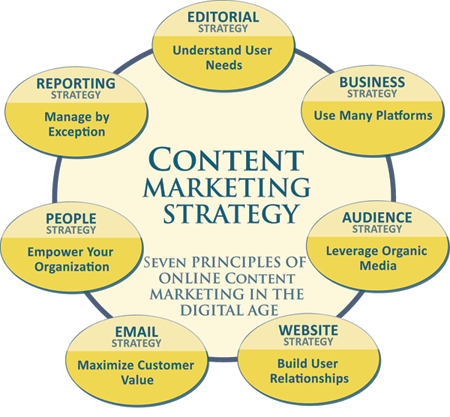
Always think strategy

Yesterday I was teaching the introductory class on marketing and we were talking about what marketing is about. If there is one thing I want my students to remember after this class, it’s that marketing is not just a toolbox. if you have no strategy i.e. if you don’t define your target segment(s), neither your positioning idea or your value proposition, how can you use the right tools ?  No right tool without a clear purpose !

Same for content marketing, the current buzz ! Content marketing should not be run without thinking about it’s purpose. Otherwise, it’s just pure amusement for some geeks ! If you’re not sure about what is your strategy, ask me, I will advise you !

Content-Marketing-Strategy1.gif


Lou Gerstner inspired me

Lou always inspired me. I taught a case on his leadership style even before he joined IBM nearly 25 years ago 🙂

He’s the man who turned around IBM at the worst time of its history at the end of the 90’s.. Before that he also revamped American Express and other companies after having started his career with McKinsey. Lou is now 74 and still comment on corporate leadership   http://www.mckinsey.com/global-themes/leadership/lou-gerstner-on-corporate-reinvention-and-values

I always point out Lou Gerstner when I’m teaching the evolution from sales-oriented  to customer-oriented companies. He showed the way to change in corporate culture as a core ingredient of strategy.

Read his book Who Says Elephants Can’t Dance? (HarperBusiness), it’s now a classic ! ibm_200x399.jpghttp://www.forbes.com/2002/11/11/cx_ld_1112gerstner.html

Experiential marketing

Experiential marketing is not just a nice marketing gimmick. It should be strategic i.e. part of your value proposition ! Forget about the 4p’s ! We’re no more in the marketing of products, we’re in the marketing of experiences. Your customers should be the heroes of the stories you create for them.
Be inspired !

http://www.adweek.com/news/advertising-branding/5-experiential-marketing-activations-sxsw-you-need-see-170242

Be inspired !

We all need mentors: it’s a question of good balance, better performance and…happiness !

Mentoring is sharing experience for a better performance and a better being.

Mentoring is a one to one interaction, based on trust and understanding.

I provide personal advice to younger managers and entrepreneurs on how to approach business problems and life at work. My preferred format is one two-hour kick off meeting followed by 10 to 12 one-hour sessions (mix of on line and off line meetings). I also mentor small teams of 2-3 co-workers.

Ask for a trial session free 🙂

Thuong, 35, chief strategic officer of a major construction building  group:
“When I was put in charge of this new job, I didn’t know where to start. Should I go over this merger and acquisition proposal immediately or write a strategic plan before ? Should I hire consultants or have my own staff do the job ? I had so much in mind that I couldn’t sleep. Happily, I could book a few hours talking and working with Prof Baeyens, my ex-prof of strategy. He became my mentor. I could speak, he would listen. I got advice, I found the way to solve the problems in a structured way.”